
Empowering India's Agricultural Export Vision with APEDA
APEDA stands as the foundational support for agricultural export activities in India. The organization supports international trade activities by securing exporters’ success and brings high-quality innovations to enhance rural development.
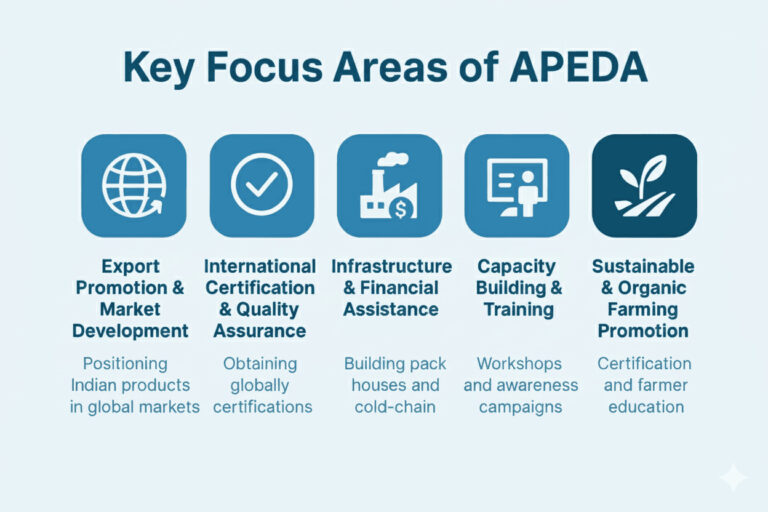
(Agricultural and Processed Food Products Export Development Authority) serves as the cornerstone of India’s agricultural export ecosystem. Functioning under the Ministry of Commerce and Industry, Government of India, The registration empowers farmers, food manufacturers, processors, and exporters to access global markets with enhanced quality, certification, and infrastructure support.The primary purpose of APEDA is to promote the export of agricultural and processed food products by building capacity, improving product quality, and ensuring India’s presence in international trade through sustainable and globally recognized practices.
Why APEDA Registration Matters:
- Enables businesses to export agricultural and processed food products legally.
- Grants access to APEDA’s financial and infrastructural support schemes.
- Strengthens brand credibility through government-recognized certification.
- Opens doors to international markets and trade exhibitions.
- Ensures compliance with global food safety and quality standards.
Obtaining APEDA registration is a vital step for any food business aiming to expand into international markets. With its comprehensive support for infrastructure, certification, quality assurance, and sustainability, APEDA continues to serve as the backbone of India’s agricultural export growth, driving farmers and exporters toward a globally competitive future.
WHAT IS APEDA AND APEDA CERTIFICATE?
The Agricultural and Processed Food Products Export Development Authority, is a statutory governmental body established in 1986 under the Ministry of Commerce and Industry, Government of India. It facilitates and regulates the export of scheduled agricultural and processed food products from India and controls imports of sugar. APEDA also acts as the secretariat for the National Accreditation Board under the National Programme for Organic Production (NPOP) for organic exports, ensuring certification and accreditation of exporters.
The Agricultural and Processed Food Products Export Development Authority Certificate, officially known as the Registration-Cum-Membership Certificate (RCMC), is a compulsory legal authorization issued by Agricultural and Processed Food Products Export Development Authority for any person or business exporting scheduled agricultural or processed food products listed under the APEDA Act. Obtaining this certificate grants exporters legal validation and access to various official government schemes, financial assistance, training programs, market development initiatives, and promotional activities conducted by Agricultural and Processed Food Products Export Development Authority.
Key highlights of the APEDA Certificate include:
Mandatory requirement to export scheduled products under the APEDA Act.
It supports exporters with brand promotion, financial aid, and infrastructure development.
Grants eligibility to participate in training and gain insights into export quality standards and target markets.
Provides credibility and global access to exporters, boosting trustworthiness and business growth in agricultural exports.
The APEDA registration process is online and involves submitting essential documents such as the Import-Export Code, bank certificates, company registration (if applicable), and paying prescribed government fees. The RCMC certificate remains valid for five years, with automatic renewal upon fee payment. Maintaining active export operations and complying with Agricultural and Processed Food Products Export Development Authorities regulations are essential for retaining registration.
In summary, APEDA and its RCMC certificate play a crucial role in validating and supporting Indian agricultural exporters, providing legal compliance, financial benefits, and market development opportunities crucial for successful global trade in agricultural products.
Why is the APEDA Certificate Needed?
The APEDA Certificate, officially called the Registration-Cum-Membership Certificate (RCMC), is a mandatory authorization issued by the Agricultural and Processed Food Products Export Development Authority (APEDA) for exporters of scheduled agricultural and processed food products from India. This certification is crucial because it ensures compliance with government export regulations while unlocking multiple benefits for exporters.
Key reasons why the APEDA Certificate is necessary:
- Legal Requirement for Exporters
Under the APEDA Act, 1985, all exporters dealing with scheduled products such as meat, poultry, dairy, basmati rice, processed foods, fruits, and vegetables must register with APEDA. Without this certificate, exporting these goods is illegal, restricting business operations in this sector. - Authorized International Trade
Possessing the APEDA Certificate grants exporters official permission to engage in international trade within Agricultural and Processed Food Products Export Development Authority’s product mandate, validating their export activities legally and formally. - Access to Government Schemes and Financial Support
Registered exporters gain eligibility for various government schemes offering financial assistance, infrastructure development, marketing initiatives, and promotional support, which are vital to scale and sustain export operations. - Enhanced Exporter Credibility
An APEDA Certificate boosts credibility with international buyers by demonstrating compliance and quality assurance, which helps in building trust and enhancing the competitive positioning of Indian agricultural products globally. - Support for Global Quality Certifications
Agricultural and Processed Food Products Export Development Authority assists exporters in acquiring essential global certifications, such as HACCP, ISO, organic certifications, and BRC standards, which are often prerequisites for entry into stringent foreign markets. - Access to Trade Intelligence and Market Data
Certificate holders benefit from critical trade insights, including detailed market research, export data trends, buyer directories, and export training programs that empower better strategic decisions.
The registration procedure is fully online via the DGFT portal and involves submitting required documents such as Import-Export Code (IEC), PAN card, bank certificates, business registration proofs, and payment of prescribed fees. The APEDA RCMC certificate is generally valid for five years, with renewal options available.
In essence, the (Agricultural and Processed Food Products Export Development Authority) Certificate is indispensable for legally compliant, credible, and globally competitive agricultural export activities in India, providing exporters with regulatory approval, financial incentives, market access, and ongoing support to thrive in the international marketplace.
Who Needs the APEDA Certificate?
The APEDA (RCMC) Certificate is mandatory for exporters dealing with scheduled agricultural and processed food products as defined under the APEDA Act. It is essential for manufacturers, exporters, and trading companies involved in the export of fruits, vegetables, meat, poultry, dairy products, basmati rice, and organic agricultural items.
Merchant exporters who buy produce directly from farmers or manufacturers for export without processing, as well as manufacturer exporters who handle processing, packaging, and branding of food products like ready-made foods, pickles, snacks, dairy, and meat, must obtain this registration.
The Agricultural and Processed Food Products Export Development Authority Certificate not only ensures legal compliance but gives exporters access to valuable government benefits, export promotion opportunities, financial aid, and infrastructure support. It validates the exporter’s business, facilitating smoother international trade and enhancing credibility with global buyers.
Registering for the APEDA RCMC seamlessly integrates exporters into India’s organized agricultural export ecosystem while expanding their market reach.
Documents Required for APEDA Registration
The following documents must be supplied for obtaining the APEDA Registration-Cum-Membership Certificate (RCMC):
Mandatory Documents:
- APEDA issues the Import-Export Code (IEC) under authorization from DGFT.
- A PAN Card belongs to the business entity or its proprietor
- A Bank Certificate should show applicant account details either through the bank’s official letterhead or by presenting a Cancelled Business Bank Cheque.
- Business Registration Proof (any one): Certificate of Incorporation (for Companies), Partnership Deed (for Firms), GST Registration Certificate, or MSME/Udyam Registration (if applicable)
- The business must provide official documentation showing its address through utility bills or lease deeds and similar documents.
- Your submission must include an official list which provides contact information for all directors and their partners together with details about the proprietor.
- Email ID and Mobile Number for registration and communication
Additional (if applicable):
- FSSAI License (for food product exporters)
- NPOP Certificate (for organic exporters)
- An authorization letter alongside board resolution from companies should be provided in order to establish an authorized signatory.
Benefits of APEDA Registration
For Indian exporters who handle scheduled agricultural and processed food products, there must be APEDA (Agricultural & Processed Food Products Export Development Authority) registration. Your export enterprise derives the following achievements from registering with APEDA:
- Legal Authorization for Export
All exporters of APEDA-scheduled food products including fruits, vegetables, cereals, meat, and dairy goods need this registration for their exports from India. The export of these goods from India demands legal compliance according to Indian laws. - Access to Financial Assistance
APEDA’s registered exporters gain access to financial schemes at different stages through their registration.
- Market Development
- Infrastructure Support
- Quality Improvement
APEDA provides reimbursement for essential export-related services which include laboratory testing and packaging as well as barcoding in addition to promotional activities.
- Export Market Development
Agricultural and Processed Food Products Export Development Authority advances Indian agri-products worldwide by actively performing market promotion activities.
- Brand-building support
- Participation in international trade fairs
- The organization provides exporters access to market research as well as export intelligence reports through their programs.
- Training & Capacity Building
Through Agricultural and Processed Food Products Export Development Authority programs exporters obtain access to specialized trainings and educational sessions which include seminars and workshops.
- Packaging techniques
- International trade practices
- Quality standards
- The organizations become more competitive in the export market thanks to this support.
- Support for Quality Compliance
Agricultural and Processed Food Products Export Development Authority delivers assistance to exporters in their goal to meet international food standards which include FSSAI and HACCP and ISO standards. The organization provides help to exporters for getting required export certifications. - Infrastructure Development Assistance
The organization provides monetary assistance for exporters to establish:
- Cold storage units
- Pack houses
- Pre-cooling facilities
- Processing units
The support enhances both the supply chain process efficiency while extending shelf life of products.
- Global Market Recognition
Agricultural & Processed Food Products Export Development Authority registration creates a credible foundation for your export operation since it helps build substantial trust with overseas buyers who find it easier to conduct business under these conditions. - Support for Organic Product Exports
Agricultural and Processed Food Products Export Development Authority functions as the organizational agency which oversees all organic exports from India. It assists with:
- Certification under the National Programme for Organic Production (NPOP)
- Global promotion of Indian organic products
- Online Export Facilitation
Agricultural and Processed Food Products Export Development Authorities digital platform enables:
- Easy product registration
- Online subsidy applications
- Status tracking
- Access to circulars and updates
- Lifetime Validity
Agricultural and Processed Food Products Export Development Authorities registration operates with lifetime validity unless agri-exporters maintain their compliance standards making it a single long-lasting investment for exporters.
(Agricultural and Processed Food Products Export Development Authority) plays a pivotal role in promoting India’s agricultural exports. Established by the government,it supports exporters by providing certified registration, known as the RCMC (Registration-Cum-Membership Certificate), which is essential for legal compliance and market entry.
The certificate enhances credibility, enabling exporters to access global markets confidently. It offers numerous advantages, including eligibility for government schemes, financial incentives, and market development programs. It also helps exporters secure international quality certifications like HACCP, ISO, and organic standards, which are critical for foreign market access. Additionally, it provides vital market intelligence—trade data, export trends, and buyer directories,empowering exporters to make informed decisions.
Leveraging Agricultural and Processed Food Products Export Development Authorities benefits not only ensures regulatory compliance but significantly boosts export potential, global competitiveness, and brand recognition for Indian agricultural products. Maximize your export growth by harnessing Agricultural and Processed Food Products Export Development Authority comprehensive support system today.
Penalties for Non-Compliance with APEDA Regulations
APEDA rules violation leads exporters to face severe penalties. Law enforcement authority rests with the Agricultural & Processed Food Products Export Development Authority through the Agricultural and Processed Food Products Export Development Authority Act of 1985 to sanction exporters who break rules or miss necessary export standards.
1. Cancellation of Registration
The registration of exporters may be cancelled or suspended according to the powers of Agricultural and Processed Food Products Export Development Authority.
- The exporter presented incorrect details to Agricultural and Processed Food Products Export Development Authority during their registration process.
- The exporter does not abide by the directions or guidelines issued by APEDA.
- The rules and conditions of Agricultural and Processed Food Products Export Development Authority suffer from non-compliance.
A canceled registration from Agricultural and Processed Food Products Export Development Authority prevents the exporter from continuing legal exports of scheduled products.
2. Monetary Penalties
The financial consequences of breaking Agricultural and Processed Food Products Export Development Authority regulations become a required penalty for exporters. The amount depends on:
- Nature and seriousness of the offence
- Frequency of non-compliance
- The extent to which the violation affects both the industry sector and its related trade operations
Export activities will face restricted operations when exporters fail to pay their penalties.
3. Inspections and Legal Proceedings
Agricultural and Processed Food Products Export Development Authority possesses the authority to perform inspections together with audits within exporter facilities. Agricultural and Processed Food Products Export Development Authority can launch an inspection structure to determine any legal violations which have been discovered.
- Seize relevant documents or records
- Agricultural and Processed Food Products Export Development Authority recommends legal action through alternative acts such as Food Safety Standards of India (FSSAI), Foreign Trade Policy (DGFT), and Indian Customs.
4. Loss of Government Benefits
Agricultural and Processed Food Products Export Development Authority will revoke multiple benefits from exporters who do not comply with regulations.
- Financial assistance and subsidies
- Exporters can receive assistance from APEDA regarding both brand marketing activities and product packaging services.
- Exporters who participate in global trade fairs as well as buyer-seller meets
5. Reputational Damage
Agricultural and Processed Food Products Export Development Authority norm violations result in two main negative impacts which lead to degradation of an exporter’s reputation.
- Termination of export contracts
- Loss of credibility in international markets
- Reduced trust among buyers and trade partners
Stay Compliant to Grow Globally
Meeting Agricultural and Processed Food Products Export Development Authority guidelines allows your business to maintain operational ease in exports and qualifies you for government aid and earns better trust from global markets.
Frequently Asked Questions (FAQs) about APEDA
- What is APEDA?
Agricultural and Processed Food Products Export Development Authority is a government authority under the Ministry of Commerce and Industry dedicated to promoting the export of scheduled agricultural and processed food products from India. - What is the APEDA Certificate?
The APEDA Certificate, or Registration-Cum-Membership Certificate (RCMC), is a mandatory legal authorization for exporters of APEDA-scheduled products. It grants exporters access to export benefits and government support programs. - Who needs APEDA registration?
Every exporter, business entity, merchant, manufacturer, Farmer Producer Organization (FPO), and startup dealing with scheduled products like fruits, vegetables, meat, poultry, dairy, and organic produce must register with Agricultural and Processed Food Products Export Development Authority. - Is APEDA registration compulsory for all agricultural exporters?
Registration is required only for exporters of products listed under Agricultural and Processed Food Products Export Development Authority’s scheduled product list. Exporters outside these sectors should join relevant export councils. - What are the benefits of APEDA registration?
Registered members access export subsidies, financial support for infrastructure, quality certification services, market promotion, participation in trade fairs, and training programs. - How long is the APEDA Certificate valid?
The APEDA Certificate has lifetime validity unless revoked due to non-compliance. Exporters must update business details regularly to maintain compliance. - How to apply for APEDA registration?
Apply online on the official Agricultural and Processed Food Products Export Development Authority portal by submitting required documents, filling out the application form, and paying the prescribed fee. - What if an exporter is unregistered with APEDA?
Failure to register may result in suspension of export rights for scheduled products, disqualification from government schemes, and a damaged market reputation. - What is APEDA and why is it important for agricultural exporters in India?
(Agricultural and Processed Food Products Export Development Authority) is a government authority under the Ministry of Commerce and Industry that promotes the export of scheduled agricultural and processed food products from India. It provides legal authorization, export facilitation, and marketing support essential for competitive global trade. - How do I apply for APEDA Registration and obtain the RCMC certificate?
Apply online on the official APEDA portal by submitting the required documents, filling out the application form, and paying the prescribed fee. Upon approval, the Registration-Cum-Membership Certificate (RCMC) is issued, authorizing export of scheduled products. - Which exporters are required to get APEDA RCMC registration for agricultural products?
All exporters dealing in scheduled products like fruits, vegetables, cereals, meat, poultry, dairy, organic products, and processed foods must obtain APEDA RCMC registration. This includes manufacturers, merchant exporters, Farmer Producer Organizations, and startups. - What are the benefits of APEDA registration for Indian food and processed product exporters?
Benefits include legal export authorization, access to financial assistance and government schemes, infrastructure support, market development initiatives, quality certification assistance, training, and participation in international trade fairs. - How long is the APEDA Registration-Cum-Membership Certificate (RCMC) valid?
The APEDA RCMC certificate has lifetime validity unless revoked due to non-compliance. Exporters must keep their registration details updated to maintain validity. - What documents are needed to complete APEDA RCMC registration online?
Key documents include Import Export Code (IEC), PAN card, business registration proof, bank certificate, and any product-specific licenses or certifications, depending on the export category. - Can APEDA registration help exporters access government subsidies and financial schemes?
Yes, APEDA-registered exporters are eligible for various government subsidies, grants, and financial schemes that support export infrastructure, quality improvements, and market promotions. - How does APEDA support exporters in maintaining quality standards and certifications?
APEDA assists exporters in obtaining internationally recognized quality certifications like HACCP, ISO, FSSAI, and organic certifications, ensuring compliance with global market requirements. - What happens if an exporter fails to obtain APEDA registration for scheduled products?
Exporters without APEDA registration for scheduled items risk suspension of export rights, ineligibility for government benefits, and loss of credibility in international markets. - Are startups and Farmer Producer Organizations (FPOs) eligible for APEDA registration and export benefits?
Yes, startups and FPOs involved in exporting scheduled agricultural and processed food products can register with APEDA to enjoy legal recognition, export benefits, and capacity-building programs.