
Packaging Material Testing – FSSAI Compliant
At MyFoodExpert, our packaging material testing services ensure that every packaging component achieves the highest standards of food safety, quality, and regulatory compliance. We specialize in verifying that all materials in contact with food are food-grade certified, free from harmful chemicals, and fully compliant with FSSAI guidelines as well as international packaging safety regulations.
Our scientific evaluation process covers the complete lifecycle of packaging materials—from shelf entry to expiration date—ensuring that they protect food quality, extend shelf life, and safeguard consumer health.
Safe and high-quality food packaging materials are critical for ensuring food security, public health protection, and consumer confidence. Packaging does much more than hold a product—it serves as a protective shield against contamination and damage while functioning as a direct link between manufacturers and consumers.At MyFoodExpert, our comprehensive packaging material testing services ensure that every packaging component meets stringent food safety standards, FSSAI compliance requirements, and international regulations.
Our testing program is aligned with the Food Safety and Standards Authority of India (FSSAI) guidelines, including the Revised Inspection Checklist effective from 3rd April 2025. This ensures that your packaging materials undergo thorough inspections, scientific testing, and proper documentation coverage, making them 100% food-grade certified and regulatory compliant.
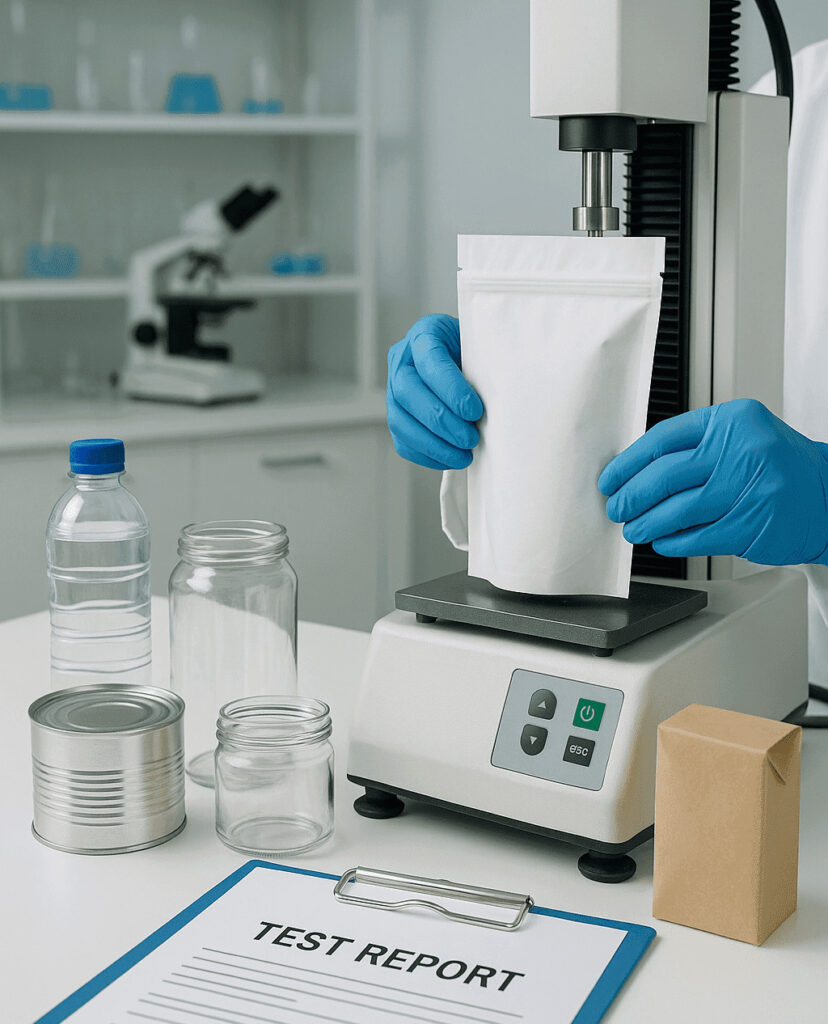
Our Packaging Material Testing Service
At MyFoodExpert, we provide fast, reliable, and regulatory-compliant packaging material testing services to ensure your products meet FSSAI requirements and global food safety standards. Our expert team of packaging specialists conducts in-depth testing on a wide range of food-contact materials—plastic, paper, glass, and metal—to verify chemical safety, physical performance, and food-grade certification.
Please send us your enquiry and get expert assistance today.
Assurance of Packaging Safety Demands Proper Material Assessment
Packaging material testing is essential for every food manufacturer, supplier, and packager who must guarantee that their packaging materials are safe, food-grade certified, and fully compliant with FSSAI standards. At MyFoodExpert, we provide end-to-end packaging compliance testing services that protect food integrity, prevent regulatory risks, and build consumer confidence. We help you:
- Protect food products from packaging-related chemical, physical, or microbial contamination.
- Meet FSSAI’s Revised Packaging Inspection Checklist (April 2025) with complete documentation.
- Prevent penalties, recalls, and shipment rejections through proactive compliance testing.
- Obtain certifications for chemical resistance, thermal stability, and mechanical safety.
- Verify packaging materials against Indian Standards (IS codes) and international benchmarks.
Materials We Test
At the packaging material testing laboratory, we provide comprehensive testing solutions for all major food packaging materials to ensure FSSAI compliance, Indian Standards (IS) certification, and food-grade safety.such as:
Paper & Paperboard Packaging Testing
Paper-based packaging is widely used in food industries for boxes, cartons, pouches, and wraps. However, it must pass strict FSSAI and IS standards to ensure it does not contaminate or degrade food products.
Tests Conducted:
- Grease resistance testing – Ensures packaging prevents oil and fat penetration.
- Pinhole and contamination detection – Detects defects that could allow microbial or chemical contamination.
- Strength & durability evaluation – Checks packaging integrity under handling and storage.
- Thickness & purity measurements – Ensures uniform quality and compliance with food-grade safety requirements.
Benefit: Certified paper packaging guarantees food safety, sustainability compliance, and audit readiness.
Glass Container Testing
Glass is considered one of the safest food contact materials but must undergo structural and durability tests to meet FSSAI and global requirements.
Tests Conducted:
- Crack, blister, and mold defect analysis – Ensures glass integrity.
- Thermal shock resistance testing – Confirms containers can withstand sudden temperature changes.
- Sealing integrity tests – Ensures airtight closures to prevent spoilage and contamination
Benefit: Tested glass packaging ensures durability, safety, and compliance with IS and international standards.
Metals & Alloys
Metal packaging (tin, aluminum, steel) is commonly used for cans, foils, and containers. Improper metal use can cause corrosion, chemical leaching, and safety risks.
Tests Conducted:
- Corrosion resistance analysis – Ensures packaging can store acidic or liquid foods without degradation.
- Chemical leaching evaluation – Detects harmful metals that could migrate into food.
- Compliance with Indian Standards (IS codes) for food-safe metals.
Untinned copper, brass, or reused tins are prohibited under ISI guidelines due to contamination risks.
Benefit: Certified metal packaging guarantees long shelf-life, rust-free performance, and safe storage.
Plastic Packaging
Plastic packaging is widely used in bottles, containers, films, and laminates. Since plastics can migrate chemicals into food, stringent testing is mandatory under FSSAI & IS standards.
Key Tests Conducted:
- Overall & specific migration testing – As per FSSAI packaging regulations to check chemical leaching.
- Compatibility checks – Ensures packaging is safe for hot, cold, liquid, and solid foods.
- Physical property testing – Strength, flexibility, and barrier properties analysis.
Testing as per IS Codes:
- IS 9845 – Migration studies for food-grade plastics.
- IS 10146 – Polyethylene (PE) safety testing.
- IS 10142 – Polystyrene (PS) compliance testing.
- IS 12252 – PET (Polyethylene Terephthalate) packaging evaluation.
- IS 10910 – Polypropylene (PP) quality testing.
- Light transmittance test (≥85%) – For PET water bottles to comply with IS standards.
Benefit: Tested plastic packaging ensures safety, durability, and compliance for domestic and export markets (FDA/EU).
- Multilayer/Composite Packaging
Multilayer packaging (plastic-aluminum-paper composites, laminated pouches) provides barrier properties, but each layer must be evaluated for food safety compliance.
Tests Conducted:
- Food-contact layer compliance – Ensures only safe materials touch the food.
- Barrier property analysis – Tests for thermal, chemical, and physical stability.
- Delamination & adhesion strength tests – To confirm structural reliability during transit and storage.
Benefit: Tested multilayer packaging guarantees extended shelf life, compliance with IS & FSSAI, and suitability for export markets.
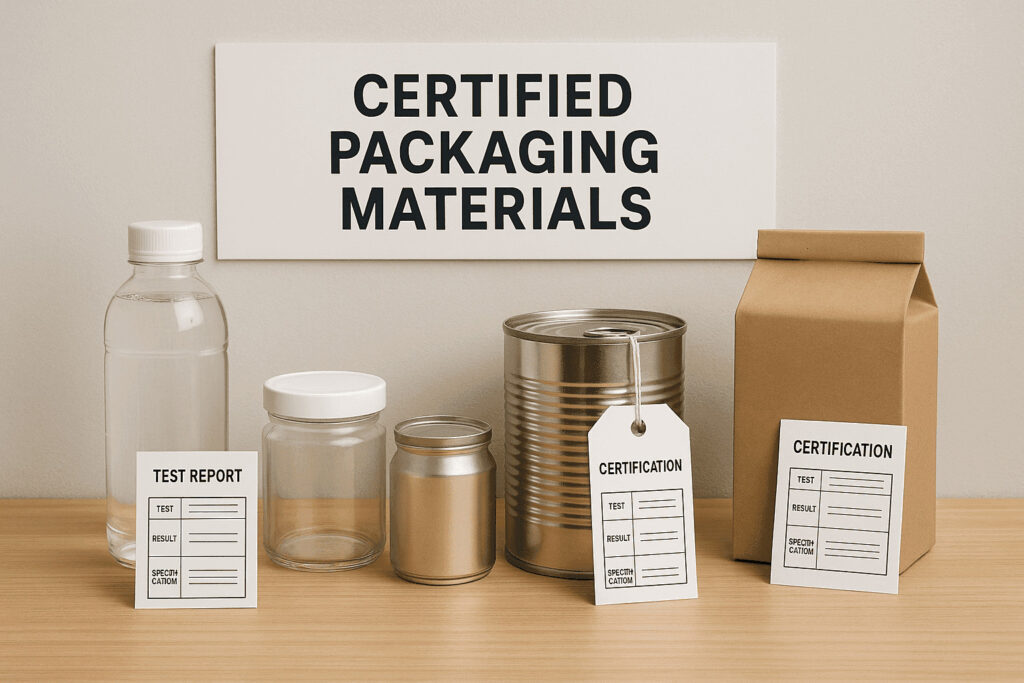
Testing & Certification Process
At MyFoodExpert, our packaging material testing services are designed to ensure complete safety, compliance, and quality assurance. Our comprehensive testing and certification process guarantees that your packaging meets all regulatory standards, providing confidence to both manufacturers and consumers.
Our services cover end-to-end testing, starting from sample collection to the issuance of a fully certified report. Each packaging material undergoes rigorous evaluation in NABL-accredited laboratories, which are equipped with advanced technology to ensure precise and reliable results.
We perform a wide range of packaging material testing to ensure quality, safety, and durability:
- Heavy Metal Content Testing: Ensure that your packaging is free from toxic metals that can contaminate food.
- Global & Specific Migration Limits: Evaluate chemical migration to ensure compliance with international food safety standards.
- Color, Odor Transfer & Leaching Tests: Detect any undesirable transfer of color, odor, or chemicals from packaging to the food product.
- Strength & Durability Testing: Assess packaging performance under storage and transit conditions, including compression, tear, and burst strength.
Each tested packaging material is provided with a Certificate of Conformity, verifying compliance with food safety regulations and global packaging standards. Our NABL-certified laboratories generate detailed, fully certified reports containing all documented results, ensuring complete transparency and traceability.
Regulatory Compliance Guaranteed
We ensure that your packaging material testing fully complies with all FSSAI regulatory requirements. Our services are designed to provide complete regulatory assurance, helping manufacturers meet domestic and international food packaging safety standards.
FSSAI-Approved Testing Protocols
We follow FSSAI-approved testing protocols for every packaging material type to ensure safety, quality, and compliance. Our testing encompasses:
- Plastic Packaging: Compliance with IS 9845 – Plastic Migration standards.
- Tin Containers: Testing according to IS 6615 for food-grade tin packaging.
- Printing Inks: Evaluation as per IS 15495 to ensure no harmful substances leach into food products.
Documentation and Traceability
At MyFoodExpert, every packaging material testing service comes with complete documentation and traceability, ensuring absolute transparency and easy audit readiness. Our system is designed to provide manufacturers and brands with fully trackable information that meets FSSAI and regulatory compliance standards.
Our documentation services include detailed records for every batch and material type tested:
- Certified Lab Test Reports from NABL-accredited laboratories, ensuring accurate and reliable results.
- Certificate of Compliance adhering to Indian Standards (IS codes) for complete regulatory assurance.
- Material Safety Data Sheets (MSDS) where applicable, detailing the chemical and safety profile of the packaging material.
Batch-wise Identification and Trace Records for full audit trails and traceability.
Our documentation system follows a specific pattern that helps you stay prepared for regulations and fulfill both FSSAI inspection needs while organizing your internal quality management.
Our Commitment to You
At MyFoodExpert, we are dedicated to delivering world-class packaging material testing services that ensure your packaging fully complies with FSSAI food safety regulations. As a specialized testing laboratory, we exclusively focus on packaging material examination, helping food businesses meet every regulatory requirement and prepare their products for safe market release.
Packaging Safety & Compliance Guaranteed
Our role as a trusted service provider is to make sure your food packaging materials are tested, certified, and proven safe for consumer use. We go beyond simple testing—we deliver complete compliance assurance so your packaging meets all Indian Standards (IS codes), FSSAI regulations, and global packaging requirements.
With MyFoodExpert, you gain dependable assurance that your packaging is safe, compliant, durable, and market-ready—helping you build consumer trust and achieve faster approvals.
Why Choose Us
Selecting the right testing partner for packaging materials is a critical step in ensuring your food products achieve maximum regulatory compliance. At MyFoodExpert, we specialize in packaging material testing services that meet the highest standards of FSSAI, IS codes, and global food packaging safety requirements. Here’s why businesses across India trust us:
1.FSSAI-Compliant Testing
All food packaging materials undergo rigorous testing using the latest FSSAI Revised Inspection Checklist (April 2025) and relevant Indian Standards (IS codes). This ensures your packaging complies with the most current food safety and regulatory requirements.
2.NABL-Accredited Laboratories
Testing is conducted exclusively in NABL-accredited laboratories, using standardized, globally recognized methods to deliver accurate, precise, and nationally accepted results.
3.End-to-End Testing & Certification Support
We manage your entire packaging examination process, including: Sample collection,Laboratory testing,Certification of compliance,Documentation generation.This provides you with a streamlined, hassle-free solution that covers every stage.
4.Material-Specific Expertise
Our laboratory is equipped to test a wide variety of food packaging materials, including: Plastic packaging,Paperboard and cardboard,Glass and metal containers,Multilayer laminates.Each material is evaluated for its unique properties and associated risk assessments, ensuring safe, durable, and compliant packaging.
5.Fast Turnaround & Clear Reporting
We understand that time-to-market matters. That’s why we deliver rapid, reliable packaging material testing with audit-ready reports, ensuring clarity, compliance, and confidence in every result.
6.Transparent Pricing & Dependable Service
With no hidden charges, no unnecessary delays, and complete transparency, we provide reliable support throughout the testing and certification process. Our clients trust us for professional, ethical, and efficient packaging material testing services.
Not sure which test to book?
Send us an enquiry or call, we will help you with the appropriate test for your requirement.
FAQs on Packaging Material Testing
1. What is packaging material testing?
Packaging material testing is the scientific evaluation of materials (plastic films, paperboard, glass, metal cans, laminates, etc.) used to package food products. It involves checking chemical, physical, and sometimes microbiological properties to confirm the packaging is truly “food-grade.” In practice, labs analyze things like chemical migration (what substances might leach into food) and structural integrity. The goal is to ensure every food-contact material is safe, free of harmful chemicals, and compliant with FSSAI and international standards
2. Why is packaging material testing important for food businesses?
Testing is crucial because it protects consumer health and ensures regulatory compliance. By verifying that packaging does not contaminate or degrade food, businesses avoid recalls, penalties, and shipment rejections. Proper testing ensures food remains uncontaminated, extends shelf life, and preserves quality during transport and storage. Certified testing also proves compliance with FSSAI and IS codes, strengthening brand credibility and consumer trust.
3. Which standards and regulations are followed in packaging material testing?
Food packaging must comply with FSSAI Packaging Regulations (2018), relevant Indian Standards (IS codes), and international benchmarks where applicable. Some key standards include:
- IS 9845 – Migration limits for plastics
- IS 6615 – Safety testing of tin containers
- IS 15495 – Printing inks for food packaging
Exporters also need to comply with FDA (U.S.) and EU directives (such as EU 1935/2004 and 10/2011). These regulations ensure packaging is globally accepted, reducing rejection risks in international markets.
4. What types of packaging materials can be tested?
All major food-contact packaging materials can be tested, including:
- Plastics (PE, PET, PP, PS, etc.)
- Paper and paperboard (cartons, boxes, wraps)
- Glass (bottles, jars)
- Metals (tin, aluminum, steel containers, foils)
- Multi-layer laminates (plastic-aluminum-paper composites)
Each type undergoes specialized testing—for example, grease resistance for paperboard, thermal shock resistance for glass, corrosion testing for metals, migration studies for plastics, and barrier analysis for multilayer laminates.
5. What are the common tests performed on packaging materials?
Some key tests include:
- Heavy Metal Analysis – Detects harmful metals like lead or cadmium.
- Migration Testing – Evaluates overall and specific chemical migration into food simulants.
- Color & Odor Transfer – Ensures no undesirable smells, tastes, or colors pass into food.
- Strength & Durability Tests – Tensile, compression, burst, and tear testing for physical integrity.
- Seal Integrity & Barrier Properties – Checks for leaks and stability against oxygen, moisture, or light.
These tests together ensure that packaging is safe, reliable, and suitable for long-term food contact.
6. What is a Certificate of Compliance in packaging material testing?
A Certificate of Compliance is an official document issued by the testing laboratory confirming that a packaging material meets all safety and regulatory standards. It certifies that the material is food-grade and compliant with FSSAI, IS codes, and global norms. This certificate is vital for audits, inspections, and approvals, serving as formal proof that the packaging passed required tests.
7. How long does packaging material testing take?
Turnaround time depends on the material and the scope of testing. A basic suite of tests (like migration and heavy metals) may take 1–2 weeks, while more complex tests for multi-layer laminates or export compliance could take longer. On average, most labs provide results within 1–3 weeks of receiving samples.
8. Do exporters need packaging material testing?
Yes. Export packaging must meet international standards to avoid rejection. For example, products shipped to the U.S. must comply with FDA food-contact regulations (21 CFR), while exports to Europe must meet EU 1935/2004 and 10/2011. Packaging testing ensures global acceptance, prevents costly shipment rejections, and builds confidence with overseas buyers.
9. What documentation is provided after packaging material testing?
Businesses receive a complete documentation package, including:
- Certified NABL-accredited test reports
- Certificate of Compliance/Conformity
- Material Safety Data Sheets (MSDS) where required
- Batch traceability records
These documents serve as audit-ready proof of compliance and can be presented during inspections or exports.
10. How can I get my packaging material tested?
The process is simple: businesses provide packaging samples to an accredited lab. The lab conducts the required FSSAI and IS-compliant tests, prepares a report, and issues a Certificate of Compliance. Many labs also provide end-to-end services, handling collection, testing, certification, and documentation to make the process smooth and hassle-free.
11. What happens if packaging fails the test?
If packaging fails, the lab issues a detailed report highlighting the problem and suggesting corrective measures—such as changing materials, adjusting coatings, or modifying inks. Businesses can then rework the packaging and resubmit it for testing. This feedback loop ensures that compliance is achieved before large-scale production or export.
12. How much does packaging material testing cost?
Costs vary depending on the type of packaging, number of tests, and regulatory requirements. Simple tests for single materials like PE films are more affordable than complex tests for multi-layer laminates. While costs may seem high initially, proper testing prevents expensive recalls, penalties, and export rejections, making it a critical investment for food businesses.
13. Can recycled packaging materials be tested?
Yes. Recycled plastics and other packaging materials are tested for migration, heavy metals, and contamination risks. FSSAI has issued strict guidelines for recycled packaging, including recycled PET (rPET). Testing ensures recycled packaging is safe for food contact, meets IS codes, and complies with eco-friendly packaging standards.
14. Is packaging testing mandatory for FSSAI compliance?
Yes. FSSAI regulations require all food-contact packaging materials to be tested and certified. Businesses must prove compliance with IS standards before packaging can be used. Non-compliance can lead to regulatory action, fines, and product recalls.
15. Can small food businesses also avail packaging testing services?
Absolutely. Accredited labs provide testing services for startups, SMEs, and large enterprises. Small businesses benefit equally from packaging testing since it helps build trust, ensures compliance, and supports smooth operations without regulatory risks.
16. Does packaging material testing cover sustainability compliance?
Yes. Packaging labs also test for eco-friendly and sustainable compliance. Tests may include recyclability checks, compostability (ASTM D6400, EN 13432), and biodegradability analysis. This ensures that eco-claims (like recyclable or compostable packaging) are validated with official certification, supporting sustainability goals.
17. Are migration tests compulsory for all food packaging?
Yes. Migration testing is mandatory, particularly for plastics and multilayer packaging. These tests determine how much of a chemical substance could leach into food. Without migration testing, packaging cannot be certified as safe for food contact under FSSAI or IS standards.
18. Can multilayer packaging be tested?
Yes. Laminated and composite packaging undergoes testing for each layer as well as the entire structure. Tests include migration studies, barrier property analysis, adhesion strength, and durability checks. This ensures that multilayer packaging is both safe and structurally reliable.
19. Do you provide packaging testing for exporters to the EU/US?
Yes. Many labs perform specialized tests for international markets. For EU exports, packaging must meet Regulation 1935/2004 and 10/2011. For the U.S., compliance with FDA 21 CFR regulations is mandatory. Accredited labs align their testing with both domestic (FSSAI) and global (FDA/EU) standards, ensuring acceptance worldwide.
20. How do I know if my packaging material is safe for food contact?
The only reliable way to confirm is through accredited lab testing and certification. Claims like “food grade” are not sufficient—only official test reports and Certificates of Compliance prove safety and compliance. Businesses should always request NABL-accredited reports to confirm packaging safety.
21. Why choose MyFoodExpert for packaging material testing?
Professional packaging material testing labs offer key advantages:
NABL-accredited testing for credibility
FSSAI-approved testing protocols
End-to-end support from sample collection to certification
Fast turnaround to meet deadlines
Global compliance coverage for exports
This ensures complete food safety, regulatory compliance, and market readiness.